
Product Name:HDRT High Definition Array Induction Resistivity Logging Tool
|
Type:
|
|
|
producer:
|
|
|
Description:
|
HDRT consists of 7 sub-arrays operating at 6 frequencies. Each sub-array consists of a main receiver and a bucking receiver. All sub-arrays share the same transmitter.
|
Tool IntroductionTool featuresTechnical specificationsField ExampleGeology Applications
HDRT consists of 7 sub-arrays operating at 6 frequencies. Each sub-array consists of a main receiver and a bucking receiver. All sub-arraysshare the same transmitter. The spacing of the shallowest subarray is 6 in and the spacing of the deepest subarray is 94 in. HDRT’s total original acquired signal is 96, including 84 measured signal and 12 status monitoring ones.complex and non-uniform formations, and can effectively identify oil and gas layers and determine oil and gas reserves. | 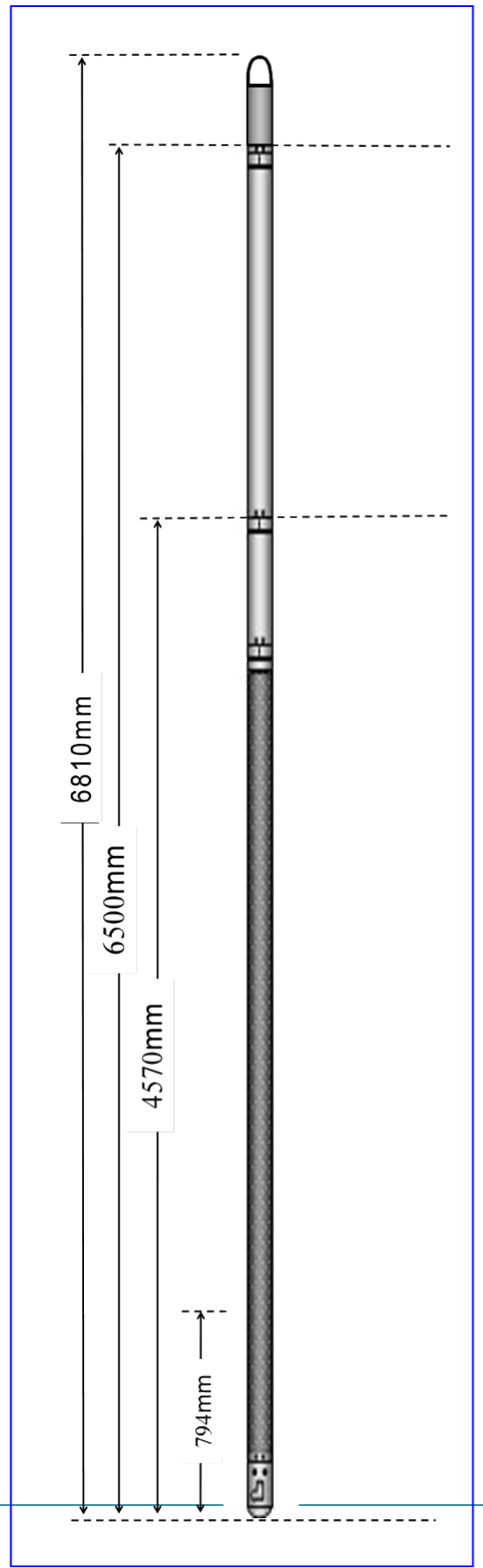
|
Calibration And Verification

With the application of advanced materials and optimized coil configuration, HDRT is the shortest in the world of the array induction tools of 120-inch depth of investigation. The precision and reliability of HDRT are achieved through a series of techniques such as real- time circuit internal calibration, real-time temperature correction, programming gain control and transmitter magnetic field monitoring.
From raw measurements, HDRT produces sets of output logs through a series of sophisticated software processing, including pre-processing, skin-effect correction, adaptive borehole correction, software focusing, vertical resolution matching and radial inversion
Temperature Pressure vibration | Working temperature range | -25 ℃ -- 175 ℃ |
MAX pressure | 140MPa |
vibration | 5 g 10 ~ 60 Hz 3D |
Shock | 50 g 11 ms |
Strain | 10000Kg |
Compression | 3000Kg |
Storage temperature | -40 ℃ -- 70 ℃ |
Technical Specifications | Power supply | 250VAC±10 % 50Hz |
diameter | Sonde: 93mm , Electronics: 92mm |
weight | Sonde: 95Kg, Electronics: 46Kg |
String location | Bottom only |
Positioning | Centered or Eccentered with standoff > 0.5in |
Borehole size range | 5 to 20 in |
Min curvature radius | 8.00m |
sampling | Depth sampling rate | 4 points/ft |
Recommended logging speed | 10 m/min |
Max. Logging speed | 20 m/min |
length | Sonde Section | With cap:4880mm,Without cap:4570mm |
Electronics Section | With cap:1770mm,Without cap:1325mm |
Total | With cap:6675mm,Without cap:6365mm |
Scale | Environment requirements | 10m away from metal mass, low position 1.5m , high position 3m |
Frequency | Every 6 months |
Measurement curve | Main logs | Vertical Resolution Matched (VRM) and True Resolution Focused (TRF) logs |
Depths of investigation | 6in, 10in, 20in, 30in, 60in, 90in, 120in |
Vertical resolution | 0.5ft,1ft, 2ft and 4ft |
Measurement accuracy | Inverted logs | True formation Resistivity (Rt), Invaded zone Resistivity (Rxo), Inner diameter (DIIN), OD (DIOU) of invasion transition zone. |
Dynamic range | 0.2 ~ 2000Ω?m |
60、90、120in | ±(1ms/m+2%*reading) |
30in | ±(2ms/m+2%* reading) |
20in | ±(4ms/m+2%* reading) |
Field Example
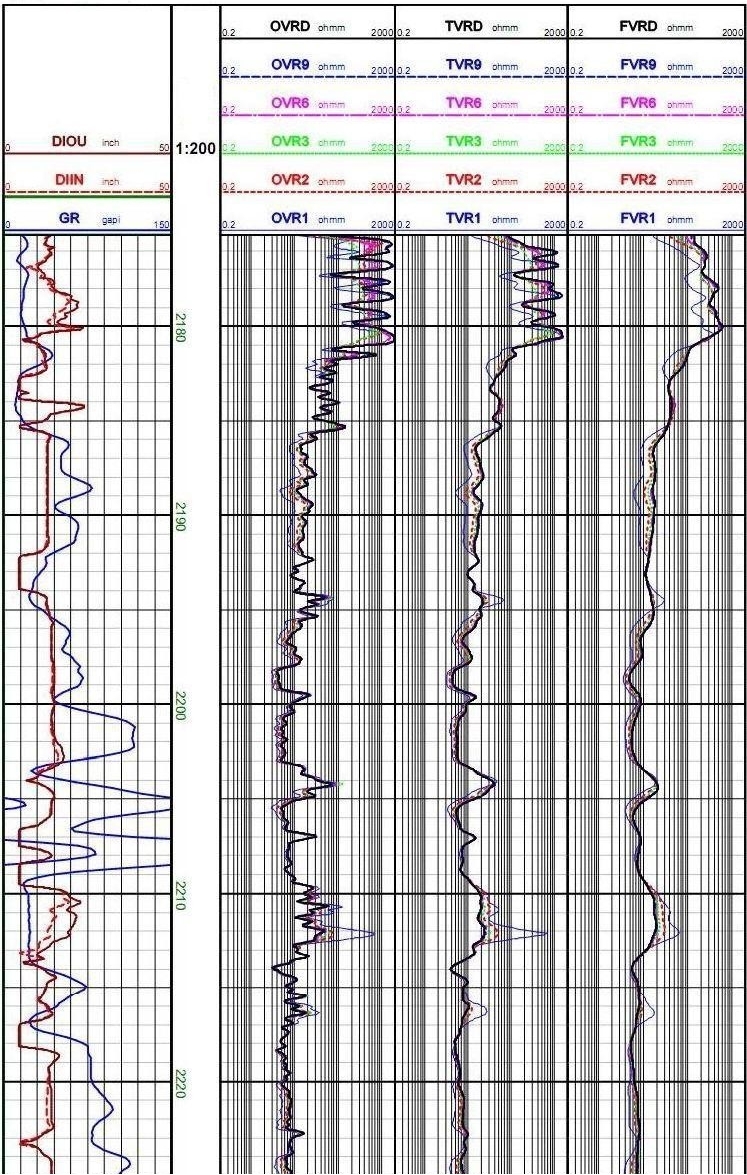
High-precision formation resistivity under complex borehole conditions,
Qualitative indentification of oil-bearing layers from water-bearing layers,
Determination of oil-water transition zone,
Quantitative calculation of the radius of mud invasion,
Qualitative grading of the reservoir permeability,
Calculation of the original formation resistivity (Rt) and invaded zone resistivity (Rxo),
Accurate evaluation of thin bed reservoir.